
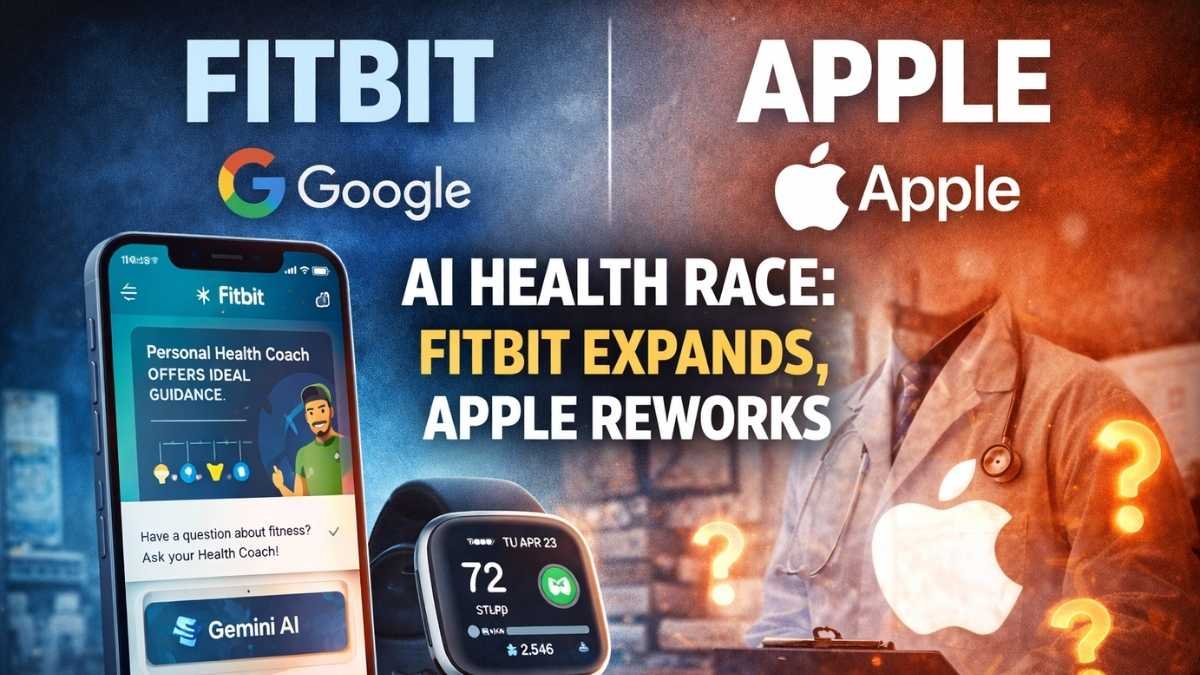
Fitbit’s Personal Health Coach is moving to iPhone — and the timing may not be accidental.
After launching the AI-powered fitness planner in public preview last October, Fitbit has confirmed that the feature will begin rolling out to iOS users over the next few weeks. The expansion brings the Fitbit Personal Health Coach to a wider audience, powered by Google’s Gemini AI models.
The tool works as a conversational assistant inside the Fitbit app. Users can ask it to create a marathon training plan with a specific completion date, adjust workouts based on their current fitness levels, and adapt schedules if plans change. The system draws on historical health data to personalise suggestions.
It remains in public preview, meaning users may encounter occasional errors as Fitbit gathers feedback before a wider release.
Why This Expansion Matters
The arrival of Fitbit’s AI health coach on iPhone comes just days after reports suggested Apple is scaling back development of its own AI doctor feature within the Health app. According to sources cited by Bloomberg, Apple is narrowing the scope of the project and focusing instead on letting Siri answer selected health questions.
That shift creates space for competitors.
With Gemini AI integrated into its fitness platform, Fitbit is positioning itself not just as a tracker brand but as an AI workout planning app that actively guides users rather than simply recording data.
Subscription and Device Requirements
Access to the Fitbit AI health coach requires a Fitbit Premium subscription and a compatible modern tracker. There are currently 13 supported devices, including:
-
Entire Pixel Watch lineup
-
Fitbit Charge 5 and 6
-
Inspire 2 and 3
-
Luxe
-
Sense and Sense 2
-
Versa 2 and 3
This tight hardware ecosystem ensures deeper integration but also limits casual access.
Early Feedback Signals Strength
PCMag’s Andrew Gebhart tested the feature over five weeks and described it as the most effective AI fitness coach he has used so far. While noting that refinements are still needed, he found the system helped improve both motivation and measurable fitness progress.
That kind of early endorsement strengthens Fitbit’s positioning as more than a passive data tracker.
Global Rollout
Alongside its expansion to iPhone, Fitbit is introducing the feature to Australia, Canada, New Zealand, Singapore and the UK. It will be available in those regions on both Android and iOS.
The Bigger Picture
Wearable devices have spent years collecting health data. The shift now is toward interpretation.
If Fitbit’s AI health coach can reliably convert stored data into actionable plans, it could redefine how users interact with fitness trackers — especially at a time when Apple appears to be recalibrating its own AI health ambitions.
The next few months will show whether conversational AI becomes a core fitness feature or remains an experimental add-on.