
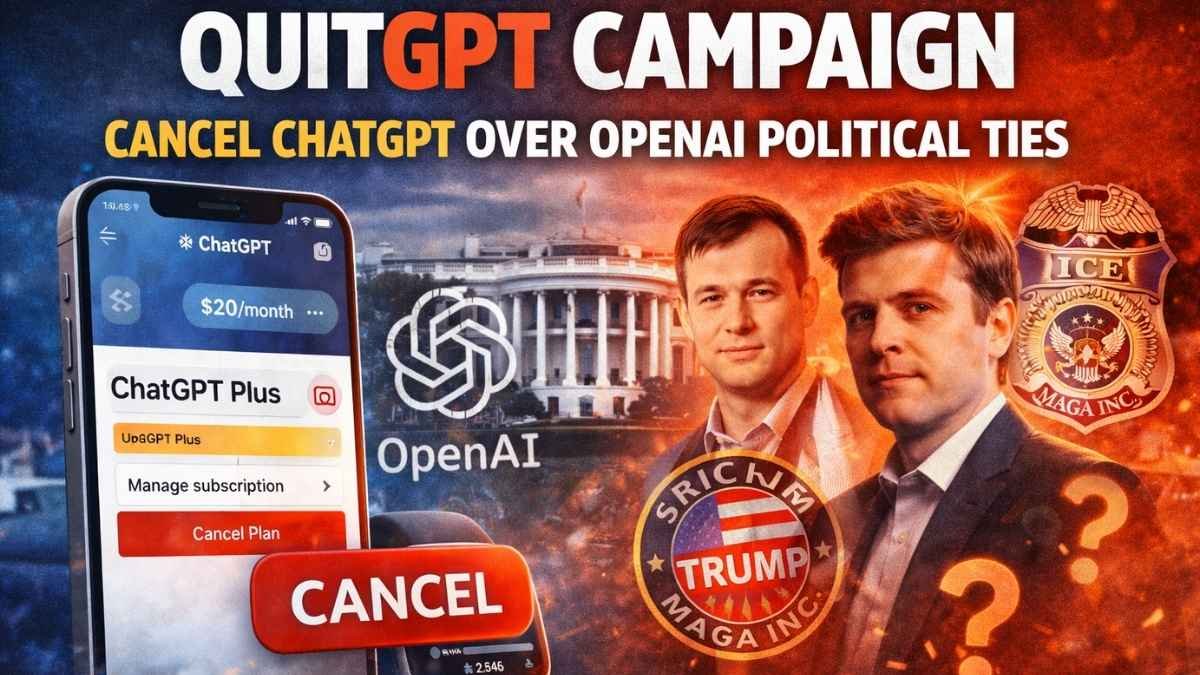
A growing online campaign called the QuitGPT campaign is urging users to cancel their ChatGPT subscriptions — and it’s quickly gaining traction across social media.
What began as a Reddit post has turned into a wider ChatGPT boycott movement, with thousands of users claiming they’ve either canceled or plan to cancel their subscriptions. The trigger, organizers say, is a mix of politics and corporate alignment.
At the center of the backlash is news that OpenAI president Greg Brockman and his wife each donated $12.5 million to MAGA Inc., a super PAC supporting former President Donald Trump. The Greg Brockman MAGA Inc donation accounts for nearly a quarter of the PAC’s fundraising in the latter half of 2025, according to campaign finance reports cited by activists.
For some users, that revelation was decisive.
Alfred Stephen, a freelance developer in Singapore, said he had already been frustrated with ChatGPT’s coding responses. But learning about the political donation pushed him to cancel his paid plan. When prompted with an exit survey asking why he was leaving, he wrote: “Don’t support the fascist regime.”
Politics Meets AI Tools
Activists also point to the use of an OpenAI ICE resume screening tool, referencing a Department of Homeland Security AI inventory that lists ChatGPT-4 as powering résumé screening within US Immigration and Customs Enforcement.
ICE has faced scrutiny following controversial enforcement actions earlier this year. Organizers argue that the connection between OpenAI technology and federal immigration enforcement raises ethical concerns.
OpenAI did not respond to requests for comment.
Social Media Momentum
As of December 2025, ChatGPT reportedly had nearly 900 million weekly active users. It remains unclear how many have joined the boycott. But the movement’s visibility is growing.
A recent Instagram post linked to the campaign crossed 36 million views and 1.3 million likes. Organizers say more than 17,000 people have signed up through their website, pledging to cancel subscriptions, stop using ChatGPT, or spread the message.
Some users have announced plans for a “Mass Cancellation Party” in San Francisco — a tongue-in-cheek protest referencing internal jokes about older GPT models being retired.
Will It Actually Hurt OpenAI?
Experts say most consumer boycotts struggle to create measurable corporate change unless participation reaches a critical mass.
Dana Fisher, a sociologist at American University, says subscription cancellations only become influential when enough consumers use their spending power collectively. “The pressure point,” she notes, is when economic behavior shifts at scale.
So far, OpenAI employees contacted by reporters have said they were unfamiliar with the campaign.
A Wider AI Backlash?
The movement appears to be part of a broader wave of activism targeting major tech companies. Marketing professor Scott Galloway has launched a parallel initiative urging people to unsubscribe from large tech platforms in February as a protest against corporate ties to political power.
The broader discontent isn’t limited to politics. Organizers cite concerns over AI’s energy demands, deepfake content, mental health effects on teenagers, job displacement fears and the rapid scaling of data centers.
Some tech CEOs have begun responding to employee pressure internally. OpenAI’s Sam Altman reportedly wrote in an internal Slack message that ICE is “going too far.” Apple CEO Tim Cook called for “deescalation” in a staff memo.
What This Means
For now, the ChatGPT subscription cancellation push remains symbolic rather than structural. But it highlights a shift in how users view AI platforms — not just as tools, but as political actors.
Whether the QuitGPT campaign dents OpenAI’s user base is uncertain. What’s clearer is that AI companies are no longer operating in a neutral lane. Users are beginning to connect product use with political consequence — and some are acting with their wallets.