
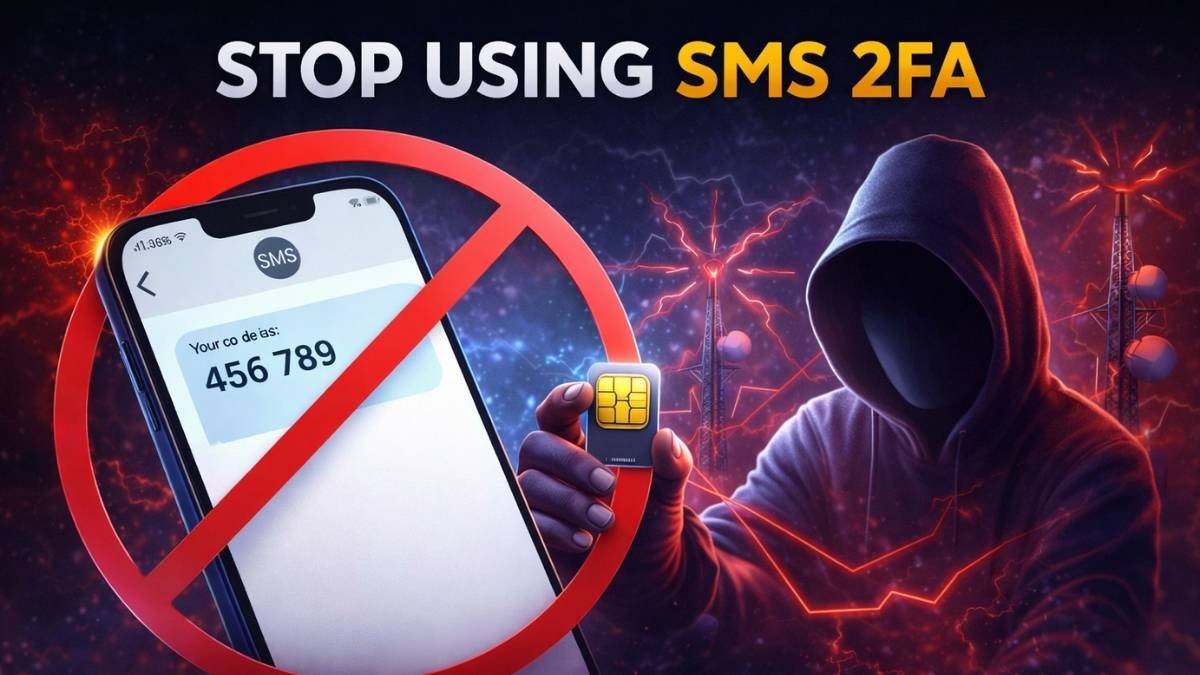
Two-factor authentication is supposed to protect you. But if you’re still receiving your codes through text messages, it might be time to rethink that setup.
The message here is simple: Stop SMS 2FA — especially if it’s linked only to your phone number.
Most people choose SMS because it’s easy. No app to install. No technical setup. Just enter your number and get a code. It works on old phones. It doesn’t need internet. It feels universal.
But convenience often hides weakness.
The Problem With SMS Two-Factor Authentication
The biggest issue isn’t the code itself. It’s the delivery system.
The SMS two-factor authentication risk begins with the infrastructure it relies on. Text messaging runs on an old signaling protocol called SS7 — a system developed decades ago when telecom networks were smaller and considered “trusted.”
The SS7 security flaw is serious: it was never designed with modern cyber threats in mind. There is no strong cryptographic verification. If someone gains access to the telecom signaling layer, they can intercept messages.
Worse, SMS messages are not end-to-end encrypted. Unlike apps such as WhatsApp or iMessage, text messages travel largely in plain text. If intercepted, the code can be read immediately.
It’s not just about the code. Attackers can also access metadata like your phone number, location information, and routing details.
SIM Swapping: The Real-World Threat
Even if no one exploits SS7, your phone number itself is vulnerable.
A SIM swapping attack is one of the fastest-growing fraud methods. Here’s how it works:
A hacker contacts your mobile carrier pretending to be you. Through phishing or social engineering, they convince the carrier to transfer your phone number to a new SIM card.
Once that happens, all your SMS messages — including login codes — go to them.
They don’t need your password. They don’t need your phone. They just need your number.
If your banking, email, or crypto accounts rely on SMS 2FA, that one transfer can unlock everything.
What Happens If You Change Your Number?
There’s another overlooked risk.
If your 2FA is tied only to your phone number and you change it — or lose access temporarily — you may lock yourself out of critical accounts.
Recovering access can take days or weeks. In some cases, it becomes a full identity verification battle.
Your phone number is not permanent. Your digital identity shouldn’t depend entirely on it.
Authenticator App vs SMS: A Safer Option
Instead of SMS, security experts recommend using an authentication app.
The authenticator app vs SMS difference comes down to control.
Apps like Google Authenticator, Microsoft Authenticator, or Authy generate time-based one-time codes directly on your device. These codes:
Don’t rely on telecom networks
Aren’t transmitted over SMS
Cannot be intercepted via SS7
Are not affected by SIM swaps
Even better: hardware security keys offer an even stronger layer of protection.
The Bottom Line
Two-factor authentication is essential. But the delivery method matters.
SMS was never built for high-security environments. It’s widely used because it’s simple — not because it’s secure.
If your bank account, email, crypto wallet, or payment app still uses text messages for login codes, now is a good time to review your settings.
Stopping SMS-based authentication doesn’t mean removing 2FA. It means upgrading it.
Security should evolve. SMS didn’t.